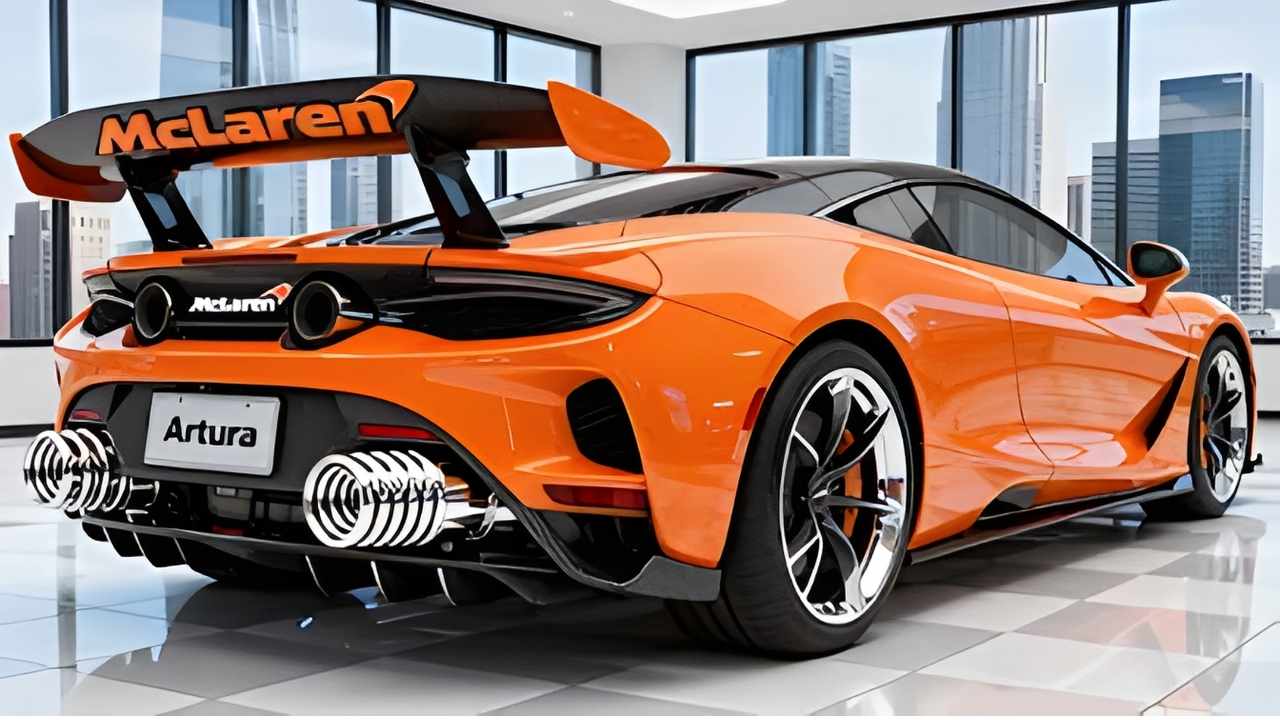
The McLaren Artura 2026 Lightning Phantom concept represents a dramatic step toward the future of hybrid supercar design. McLaren has long been known for its purity of engineering, lightweight construction, and unmistakable aerodynamic language. This concept takes those foundations and pushes them further, exploring what a next-generation hybrid powertrain could deliver when paired with bolder styling and advanced materials.
The Lightning Phantom name hints at its personality: fast, sharp, and electrifying. The exterior design imagines a more sculpted interpretation of McLaren’s aerodynamic mastery. Deeper air channels, more aggressive rear sculpting, and a futuristic lighting signature give the concept a commanding presence. While maintaining Artura’s recognizable silhouette, the Lightning Phantom takes on a more dramatic, almost predatory stance that signals its intentions instantly.
The cabin, in this conceptual vision, reflects McLaren’s ongoing commitment to driver connection. Minimalism meets technology with a clean cockpit layout, lightweight structural materials, and enhanced digital interfaces that stay focused on the essentials. Unlike overly complex supercar interiors, the Lightning Phantom envisions a balanced approach—functional, elegant, and performance-oriented.
Under the surface, the concept imagines a refined hybrid powertrain with increased electric output, reduced weight, and sharper throttle response. Improved thermal management, lighter battery packs, and an upgraded combustion engine platform would allow the Lightning Phantom to deliver faster acceleration without compromising efficiency or driving feel.
What is the Philosophy Behind the Lightning Phantom’s Design Direction?
The philosophy guiding this concept centers on blending raw performance with futuristic artistry. McLaren has always prioritized aerodynamic perfection, but the Lightning Phantom pushes that philosophy into more expressive territory. Every curve and vent seems designed not just for function but for emotional impact.

The concept’s design language imagines a world where engineering freedom is no longer limited by traditional manufacturing approaches. Advanced composite materials, adaptive aerodynamic components, and new chassis bonding technologies could allow McLaren to sculpt shapes that were previously impractical. This approach gives the Lightning Phantom a dynamic identity that feels both grounded in McLaren heritage and boldly forward-looking.
The philosophy also embraces hybrid evolution. McLaren’s goal is not simply to reduce emissions but to use electrification as a performance weapon. The rumored enhancements in electric torque delivery, improved battery cooling, and smarter energy distribution systems would make the Lightning Phantom more responsive, more agile, and more capable of sustained high-performance driving.
In a market where supercars are increasingly becoming tech showcases, the Lightning Phantom concept imagines a future where technology enhances the driving experience without overshadowing the human connection. This balance is central to McLaren’s identity and remains a guiding principle for the concept.
When Does the Lightning Phantom Concept Reveal Its True Potential?
The Lightning Phantom concept shows its potential most clearly when envisioning real-world performance scenarios. On high-speed circuits, its advanced aerodynamics would create immense stability. Revised downforce channels, active airflow management, and lightweight aero elements could keep the car planted even at extreme speeds, allowing drivers to push harder with confidence.
During rapid acceleration, the concept’s imagined hybrid improvements would shine brightest. Faster electric torque response, optimized power blending, and reduced drivetrain lag would transform the launch experience. Even without official numbers, one can imagine the Lightning Phantom flirting with record-setting acceleration figures.

The concept also reveals its potential on winding mountain roads or technical tracks where chassis balance matters more than outright speed. A lighter battery system combined with a re-engineered hybrid platform could lower the center of gravity and sharpen handling feel. This would allow the Lightning Phantom to carve through corners with precision reminiscent of McLaren’s purest track-focused models.
Even in everyday driving scenarios, the concept’s technology shows promise. Extended electric-only range, smarter hybrid modes, and improved ride refinement would make it more usable than traditional supercars. This versatility hints at a future where extreme performance cars can be both thrilling and practical.
How Would the Lightning Phantom Push McLaren’s Performance Boundaries?
The Lightning Phantom concept imagines several ways in which McLaren could redefine its performance limits. One of the most significant is weight reduction. McLaren has always prioritized lightweight engineering, but future materials such as graphene-enhanced carbon composites or advanced structural laminates could push the boundaries even further. Reducing weight not only improves acceleration but enhances braking, handling, and efficiency.
Another major advancement comes from powertrain development. A reworked twin-turbo V6 coupled with a next-generation electric motor could deliver extraordinary power density. With better thermal control, the hybrid system could sustain high power output longer without overheating—one of the biggest challenges in current hybrid supercars.
Aerodynamic innovation is also central to the Lightning Phantom’s performance leap. Adjustable airflow panels, active cooling tunnels, and dynamic rear surfaces could adapt to different driving situations in real time. On straights, the body could reduce drag; in corners, it could increase grip. This adaptive approach is becoming increasingly important in modern performance engineering.

Finally, the concept hints at a new era of digital integration. Smarter driving modes that learn from driver behavior, track-optimized predictive systems, and real-time aerodynamic adjustments could elevate the driving experience in ways that feel intuitive rather than automated. This keeps the driver at the center of the performance equation, honoring McLaren’s racing DNA.
How Does the Lightning Phantom Strengthen McLaren’s Vision for the Future?
The Lightning Phantom concept serves as a bold signal for where McLaren’s future could be heading. In a world where electric hypercars, digital interfaces, and cutting-edge materials are becoming standard, McLaren must evolve while staying true to its core identity. This concept does exactly that—it respects the brand’s heritage while looking boldly forward.
By embracing hybrid evolution, prioritizing lightweight engineering, and exploring expressive design, McLaren positions itself for the next era of performance vehicles. The Lightning Phantom concept shows that the brand is not interested in copying trends but in shaping them.
It also strengthens McLaren’s commitment to creating vehicles that are not just fast but emotionally engaging. At a time when many automakers are leaning heavily into automation and digital control, the Lightning Phantom reminds the world that driving passion should remain at the heart of performance.
This concept, even as an unofficial vision, captures the imagination because it feels like the natural next step in McLaren’s journey—a blend of art, engineering, speed, and innovation that looks toward the future without abandoning the soul of driving.