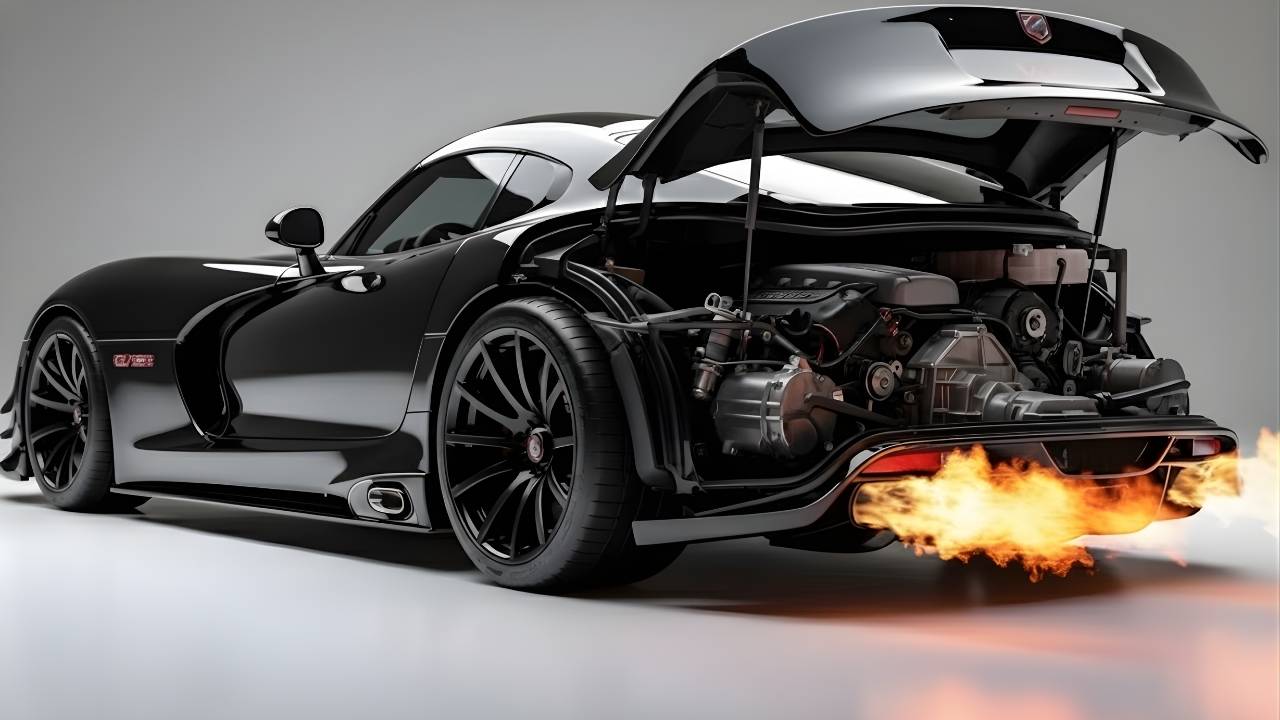
The Viper has always been an icon of raw muscle, but the 2026 Dodge Viper SRT takes that legacy to an entirely new altitude. It leaves behind the old-school reputation of being a wild car that demands taming, and steps into the modern performance arena with precision, control and insane power delivery. The foundation remains the same — massive engine up front, rear-wheel drive fury and a silhouette that screams American supercar — but everything else has been revamped to chase down European tech-heavy rivals.
The heart of the 2026 Viper SRT is a hand-built 9.4-liter naturally aspirated V10 pushing a brutal 865 horsepower and 845 Nm torque. Dodge hasn’t moved toward hybrid assistance or turbocharging. Instead, they doubled down on mechanical purity, focusing on higher combustion efficiency, lightweight internals and improved cooling. The throttle response is instantaneous, and the growl from the titanium exhaust isn’t something speakers reproduce — it’s real, untamed and addictive. On the track, 0–100 km/h comes in just 2.6 seconds, and the top speed spins past 345 km/h, making it more than capable of standing beside — or ahead of — Ferraris and Lamborghinis.
Why Aerodynamic Evolution Drives the Viper Into a New Era
Aerodynamics used to be the Viper’s weak point. Previous generations relied more on brute force than fluid airflow. In 2026, the Viper’s entire shape has been redesigned with track science in mind. Every curve, every vent and every pressure channel has a job.
The front fascia now sits lower, guiding air smoothly over the hood and generating downforce rather than lift. The double-duct roof scoop pushes cool air to the engine and rear brakes, reducing heat during high-speed track sessions. Along the sides, the widened skirts and deeper channels feed the underbody, allowing the car to hug the asphalt rather than float over it. The rear wing — electronically adjustable — recalibrates in milliseconds according to speed, steering input and throttle position. On straights, it reduces drag for maximum speed. Going into corners, it climbs into a high-downforce stance.

This is not just visual aggression; it is functional science. Dodge claims the 2026 Viper produces 38% more downforce than the 2023 ACR while generating 14% less drag. In real racing terms, that means later braking points, higher corner entry speeds and more confidence for the driver to push. For a car once considered unforgiving, this is a new personality — precision instead of punishment.
Where Racing Dynamics Transform the Driving Experience
The biggest surprise of the 2026 Viper isn’t the horsepower; it’s the way the car manages it. The chassis has been completely re-engineered using a carbon-titanium honeycomb structure, which drops the weight by nearly 90 kilograms without sacrificing rigidity. The result is that the Viper no longer feels like a monster requiring brute strength to handle; instead, it reacts like a scalpel — sharp, predictable and balanced.
The suspension now uses adaptive magnetorheological dampers, reacting hundreds of times per second to bumps, camber changes and steering inputs. Even at insane speeds, the steering delivers clarity — the driver knows exactly what the tires are doing and how much grip remains. Launch control, traction modes and track-tuned ABS have matured, no longer stepping in abruptly but rather working with the driver.
Brakes complete the racing transformation: carbon-ceramic rotors with multi-piston calipers hold up to repeated aggressive laps without fade. On a proper circuit, the 2026 Viper behaves like it’s glued to the line you choose. On mountain roads, it feels alive, raw and communicative but never out of control.

Where the Real-World Soul Meets the Track Focus
Although the Viper is built for speed addicts, Dodge hasn’t ignored daily practicality. The cabin is now quieter at low speeds thanks to improved sound insulation. The seats are sculpted for long drives yet lock the body in place during high-g turns. The cockpit layout feels driver-first and mechanical rather than touchscreen-obsessed. Analog gauges exist alongside a digital cluster to keep the spirit of old-school performance alive.
Still, the Viper has no intention of becoming a luxury cruiser. There’s no rear seat, the trunk is compact and comfort takes a back seat to performance. Buyers don’t choose a Viper because it’s convenient — they choose it because it feels alive.
Where the 2026 Viper Stands Among Global Supercars
The new Viper wasn’t created to participate — it was designed to dominate. Dodge tested it in global circuits, benchmarking it against the McLaren 750S, Ferrari 812 GTS and Porsche 911 GT2 RS. The goal wasn’t to copy them, but to defeat them while remaining unapologetically American.
The result is a car that matches the refinement of Europe while keeping the rebellious soul that made the Viper legendary. It accelerates harder than nearly every old-school supercar, corners like a racing prototype and sounds like a wild animal that refuses to be tamed. It isn’t perfect — and that’s exactly why enthusiasts love it. The Viper is a machine you respect, not a gadget that drives itself.

Where the Future of American Muscle Is Being Redefined
In a world shifting toward electrification, the 2026 Dodge Viper SRT stands as a defiant reminder that there is still room for brutal internal-combustion performance. It doesn’t apologize, doesn’t compromise and doesn’t try to appeal to everyone. For the people who crave noise, danger, adrenaline and mechanical purity, there may never be a car like this again.
The Viper is not just a vehicle — it’s a message. A love letter to driving enthusiasts before the era of EV silence becomes permanent. A final roar that will be remembered long after trends change.
And for those lucky enough to sit behind its wheel, the 2026 Viper SRT offers something no algorithm, simulator or motor-assist system can replicate: the feeling of pure control over a brutal engine and a perfectly balanced chassis, living right at the edge of physics.